
BANDITS AND WITCHES IN ASTURIAS por Jonathan Jarrett
BANDITS AND WITCHES IN ASTURIAS -AUTOR Don JONATHAN JARRETT
I am, as the sidebar may still report by the time this post actually goes up, still slogging through Barbero and Vigil’s Formación del Feudalismo for the Aprisio paper that is hopefully also not any longer mentioned there. I have expressed myself on how heavy going this book is before, and I am torn between urging that its considerable importance makes it compulsory reading for any scholar of early medieval Christian Spain (and even non-Christian Spain, though there maybe only one chapter), and the unshakeable feeling that, if it was so set, the field would be reduced by about ninety per cent as most people gave up the will to study. That all said, and it’s nice to have it off my chest, I’ve just found something interesting. See this little nugget:
Another notice relevant to the era of Ramiro I makes manifest the great difficulties that this monarch endured in consolidating himself on the throne. These difficulties were of orders both political and, more markedly, social. Ramiro I deployed great energy against all his adversaries, members of the nobility who disputed the throne with him. The Albeldense informs us that this king found himself confronting various latrones whom we may consider as peasants in rebellion, that is to say, something similar to that which took place in the reign of Aurelio, and, combined with them, there were also persecuted wizards who were condemned to the fire; these magicians would have been practitioners of the indigenous non-Christian rites and whose roots are to be sought in the ancient organisation of society.1
In some ways this is typical for Barbero and Vigil—you can already see in my fairly close translation perhaps that this is not the most mellifluous prose ever committed to the page—but in others it is not. Most of this book is very careful much-chewed-over consideration of the evidence, but there are certain preconceptions that they had which meant that occasionally they saw something that fitted and it got straight through without critique. I’m afraid this was one such curveball. Some background first of all.

Statue of Ramiro I of Asturias outside the Palau Reial in Madrid, photo by the author
Ramiro I was King of Asturias between 842 and 850. Some sources say he was son of Bermudo I (789-791) but Barbero and Vigil show good reasons to be suspicious about such claims in the Chronicle of Alfonso III, which is among other things very concerned to show a good long ancestry for its namesake monarch and seems to have pedigrees that no other source retains.2 Also, he lived a long time before succeeding if he was born during Bermudo’s reign, and since Bermudo allegedly abdicated because he was persuaded that his having entered the diaconate a long time before barred him from royal power, it is perhaps less likely that he was having kids after abdicating. So anyway, whoever he was, Ramiro was not unopposed, and he first had to defeat a rival king called Nepotian, supposedly a relative of Alfonso II (791-842) whom they were battling to succeed. Had Ramiro not won, I imagine it would now be clear that Nepotian was the closer kin and therefore rightful heir, but Ramiro defeated and killed him and so it’s Ramiro who got written into the succession. Not that things got easier for him: two years later Vikings made one of their few descents on Spain, though Ramiro was tough enough for them, and in 846 the Muslims captured the southernwards city of León, though it is a very long way from clear that Ramiro actually controlled that area despite Alfonso III’s chronicle’s claims, which are a lot more to do with the fact that he did.3 Anyway, Ramiro was unable to laugh that one off and it stayed lost to Asturias for some time.

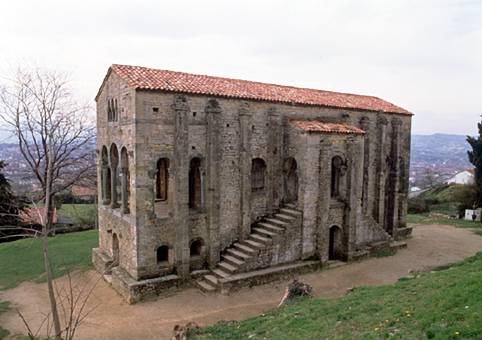
Santa Maria del Naranco, near Oviedo, previously the royal palace of Asturias, probably built for Ramiro I, image from Wikimedia Commons
Now most of my cynicism about the sources here is straight out of Barbero and Vigil, so you can tell I get on all right with that, but when it looks as if the sources might support some assertions about long continuity and ancient indigenous custom, which was kind of their deus ex machina for Asturian peculiarity, such careful sifting of evidence seems to have gone out of the window and we get things like the paragraph above, where to read it you would think that Ramiro’s opponents raised the earth and woods against him in the forms of their inhabitants. It’s like what the Telmarines must have thought when Narnia came back to life, isn’t it? So, what does the source actually say? Here’s a translation, with the Latin in the footnote:
Ramiro reigned seven. He was a rod of justice. He tore out the eyes of bandits. To wizards he put an end by fire. And the tyrants ranged against him, with amazing speed he overthrew and exterminated. Firstly he overcame Nepotian at the Bridge of Cornellana and thus came to the throne. At the same time the Northmen first came to Asturias. Afterwards of the same Nepotian along with a certain tyrant Aldroito, he blinded the eyes of both of them, and, the victor, killed the proud Piniolo. At Liño he built a church and a palace vaulted with wonderful artistry. There he passed away from this world and rests buried in Oviedo. On the day of the Kalends of February in the Era 888.4
So, er hang on, where’s this unified rural opposition again? I had Nepotian all drawn up with an army of dwarves and hags already, and that just looks like a fairly generic statement of harsh justice meted fairly to me. At the very most it’s a “no-one could kick King Ramiro’s behind! No sir! He kicked theirs! And how!” level of panegyric, not a detailed analysis of his opposition. Unlike in the slave revolt under Aurelio that Barbero and Vigil reference, I don’t see any sign here that there was any genuine peasant uprising in this note; I’m sure Asturias had enough badlands, most notably to the southern edge through which traders might be going to and from Muslim Spain, to keep a fair few bandits going. I don’t think banditry always has to indicate peasant reactions to oppressive rule, I see it more as a reaction to opportunity to make it rich quickly and run away safely, and a border land like there certainly had that.
But what about the wizards? Well, two possibilities spring to mind. Firstly, as Yves Bonnaz whose edition of the Chronicle of Albelda I’m translating there points out in his commentary, regulations against witches and wizards is a good old Visigothic tradition from when the Christianization of Spain was a lot more shaky, and if you’re writing up a good old-fashioned just king in the ninth century, that template probably appeals enough that you invoke it. In that case the chronicler is just trying to say “he enforced law like the kings of old (and thwarted all the causes of social ill mentioned in their laws as I will now list)”. In fact he may be upping the ante, as the Visigoths ‘only’ prescribed 100 lashes and scalping for wizards. Tough times call for tough justice!

Memorial stone from the church of Santianes de Pravia, capital of Asturias during the reign of Ramiro (note the interlace)
But the other possibility involves taking the threat slightly more seriously, and this the kings of the time appear to have done. In 856 King Ordoño I issued a charter to the monastery of San Julián de Samos giving them power to punish “blood-letters, bandits that have fled from the monastery and magicians” (“samguimistios, latrones refugas monasterii, magicos”—’blood-letters’ probably isn’t what that first word means but I can’t do any better with it, can you? and if you can, what about those bandits fleeing from the monastery?)5 The fact that this mission is given to a monastery shows how worldly Church power can get but also associates the missions of moral and spiritual order. We are, as Bonnaz points out (and here he has got some Barbero and Vigil on him I think), in an area where pagan practice was probably still widespread: “Crimes, vols, fuite d’esclaves sans doute, pratique de la magie ne sont-ils pas des phénomènes liés à l’instabilité persistante de ce pays?” he asks,6 because of course as we now see demon-worshippers spring up wherever political order gets a bit wobbly don’t they? Or maybe not. I think this tells us more about Dr Bonnaz and his politics than about early medieval Galicia, to be honest. So what this made me think of was, again, the seminar the other day by Celia Chazelle and her suggestion that priests who were a bit ‘local’ in their liturgical practice might be regarded as magicians by strait-laced reformers. I wasn’t too sure about that, but if you’re asking me what a monk calls or a king called priests who were in political opposition to him, and who probably entreated God against you in ways that might well have appealed to local superstitions, well, ‘magician’ or ‘wizard’ would be one answer I could accept, especially given Dr Chazelle’s various instances of the use of the Christian mystery in charms and spells by apparently sincere believers. So maybe this is what we’re looking at. Or maybe it just is staff-bearing wizards standing on mountain tops after all, but I thought that was a more modern idea…
1. Abilio Barbero & Marcelo Vigil, La Formación del feudalismo en la Península Ibérica, 2nd edn. (Barcelona 1978), pp. 262-263, translation mine.
2. Ibid., pp. 300-302 and several points thereafter. See also Amancio Isla, “Monarchy and Neogothicism in the Astur Kingdom, 711-910″ in Francia Vol. 26 (Sigmaringen 1999), pp. 41-56.
3. Barbero & Vigil, Formación, pp. 279-285.
4. Y. Bonnaz (ed./transl.), “Chronique d’Albelda” in idem, Chroniques Asturiennes (fin IXe siècle) (Paris 1987), pp. 10-30 with commentary 67-104, cap. 45. Latin, following Bonnaz’s collation: “Ranimirus regnauit septem. Virga iustitiae fuit. Latrones oculos euellendo abstulit. Magicis per ignem finem imposuit. Sibique tyrannos mira celeritate subuertit atque exterminauit. Prius Nepotianum ad pontem Narceiae superauit et sic regnum accepit. Eo tempore Nordomanni primi in Asturias uenerunt. Postea idem Nepotianum pariter cum quodam Aldroito tyranno, oculos amborum eiecit, superbumque Piniolum uictor interfecit. In locum Ligno ecclesiasm et palatia arte fornicea mira construxit. Ibique a sæculo recessit et Oueto tumulo requiescit. Sub die kalendas februarias era DCCCLXXXVIII.”
5. Antonio C. Floriano Cumbreño (ed.), Diplomática Española del Periodo Astur: estudio de los fuentes documentales del reino de Asturias (718-910) (Oviedo 1949), I p. 271 as cited by Bonnaz, Chroniques, Alb. 45 comm. n. 2.
6. Ibid.
Comentarios
Responde Clemens Radl
While I can’t do any better on the samguimistios, I am pretty sure that there were no „bandits fleeing from the monastery“, but that there were bandits and that there were people (monks, pueri oblati, servants, whatever) that fled from the monastary, thus I believe the text should read samguimistios, latrones, refugas monasterii, magicos.
By the way, I fully agree with your interpretation of the Chronicle of Albelda. There doesn’t seem to be much of an organized peasant uprising. A few days ago I commented on the lack of penitentials in Catalunya. Well, for Asturia we have the Paenitentiale Vigilanum sive Albeldense (Corpus Christianorum 156A, 1998), most probably from the second half of the ninth century, i. e. roughly the time of Ordoño I and his charter for San Julián de Samos. I’ll have to look up the edition and see what this penitential says regarding magicians. Might be interesting to see, if they just copied old Visigothic rules or if they adapted it somehow.
Responde Jonathan Jarrett
Thankyou Clemens, that makes a good deal of sense. I shan’t amend it as stands because the text in the edition is as I’ve quoted, but I think you’re probably right about how it should be read. If you get anywhere with the penitential, do let us know! That Vigila lad was a busy fellow…
Responde magistra Says
Is the point about wizards partly a way of stressing the Christian credentials of a ruler who hasn’t got many Christian deeds in his favour otherwise (one church built and no mention of other patronage/respect/protection of the church in his write-up)? But if he’s slaying wizards that means he’s not just a tough prince, he’s a tough Christian prince. I’m only surprised that they don’t also stress that he kicked pagan Viking ass (unless maybe he didn’t).
As for the idea of more magic in times of political weakness, I don’t think it’s meant in the sense of an actual increase. I think it’s based on the idea that paganism always survives among the lower orders, it’s just that the church and state are constantly repressing it, and so whenever the church’s control slips for a moment it all reappears again. (How realistic this model is depends on what you choose to define as paganism and whether various forms of Christian/non-Christian syncretism count.
Responde Jonathan Jarrett
It is weird about the Vikings: you would expect the victory to be emphasised, and the (slightly and complicatedly) later Chronicle of Alfonso III does indeed so emphasise. I think Albelda’s chronicler thought that some count or other had done the battling there and so it wasn’t one of Ramiro’s own top achievements.
As to the survival of paganism, yes, I agree and was reaching towards that myself in what I said, hence the B&V mention again; as I say, they basically wanted us to believe that really nothing changed in Asturias that the Asturians didn’t do themselves. With it put like that, I suddenly wonder where they were from… Hmm: Barbero was from Madrid, so no obvious patriotism there. Weird.
Responde Theo Says
Could ’samguimistios’ mean ‘blood-mixers’ (or even ‘blood-mixed/half-breed/mongrel’), in analogy to ’sanguisuga’ = ‘bloodsucker’ (L&S, 1627)?
Responde Jonathan Jarrett
Wow. If you were right about the `mongrel’ thing that would be an almost unparallelled but very interesting hint of actual racism. Albelda is, y’know, all cool about that stuff, but not every charter scribe may have felt the same I suppose. Thankyou for that suggestion!
Responde Theo Says
“that would be an almost unparallelled but very interesting hint of actual racism.”
Which is precisely why I’d be reluctant to use that translation. You say ‘almost unparalleled’ – do you know of any other examples of blood-racism from the period?
Responde Jonathan Jarrett
No, I was just being cagey. I mean, it depends what strength you give to words like Hagarenes and Chaldæans, doesn’t it? These are not historically correct, and they happen to be the names of tribes who were the enemies of Israel, but no-one probably knows they’re not historically correct, and it could just be a learned word for Moor or Saracen that has a convenient double-loading… or it could be an ethnic slur. And this may depend on the context.
Responde Clemens Says
First of all: I looked up the passage with the refugas in the original edition (Diplomática Española del Periodo Astur) and there it says tam sanguimistios, latrones, refugas Monasterii, magicos … (nr. 63 p. 271). So probably Bonnaz got it wrong.
Regarding the sanguimistii, I think, the etymology given by Theo is quite correct. As to the meaning, I am still not sure. Yet I am reasonably sure that it is not to be understood in a racist way, but rather, as you might say, somewhat to the contrary: it might be directed against incestuous behavior. Thus „mixing blood“ would refer to mixing your family’s blood with your own blood (and thereby contaminating it). I found one instance of a canon regarding sororate marriages with the rubrum Ut suo sanguini nemo misceatur, which could support this understanding of sanguimistii. See also Carlos de Ayala Martinez, Sacerdocio y reino en la Espana Altomedieval (2008) p. 157 who translates our passage as consanguíneos (it’s in Google Books).
As we were talking about pagan practices, superstition, and magical rites, another remotely possible meaning came to my mind: It could refer to people who mix their blood with food for medical or, rather, magical reasons. But I tend to favor the first explanation about incest.
Finally, I looked into the Paenitentiale Vigilanum (Corpus Christianorum 156A), which is a short and quite simple penitential. It was conceived and written after 830 but before 976, when the oldest extant manuscript was finished (the Codex Vigilanus, covered previously on Tenthmedieval). According to Francis Bezler, Les pénitentiels espagnols (Münster 1994) p. 8, the penitential was written around 850, which would fit perfectly with our charter of King Ordoño I from 856. Unfortunately, Bezler does not give any evidence that goes beyond the two dates mentioned above, but anyway, regarding Spanish penitentials, the Vigilanum is the only one that comes in any way close to the time and region we are talking about.
The penitential is comprised of 113 mostly very short canons, which are systematically arranged in 15 chapters. There is no introduction or preface. The sources of the Vigilanum are, as you would expect, mostly Frankish penitentials, but also some Spanish sources (Collectio Hispana). Eleven of those 113 canons are of uncertain origin. Altogether, it does not look like an intellectual or academic exercise, but gives the impression that it was designed for daily pastoral use. So we might assume that any peculiarities regarding magic or pagan rites might be there for a reason that has some connection with the surrounding reality (or its perception by the author, of course).
So, what does it have to say about witchcraft and pagan rites? There are five canons (cc. 61, 99, 100, 102, 104) which fit into this category. Three of those (cc. 99, 100, 102) have unknown sources, which could mean that they were concieved by the author with special regard to the situation in northern Spain. Another one of those (c. 61) is a combination of several Spanish sources. The remaining one (c. 104) is taken from a Frankish penitential, the so called Excarpsus Cummeani.
C. 61, which is a chapter of it’s own under the heading De maleficiis, condemns several well known magic practices which we come across in many councils or penitentials.
CC. 99–104 are all placed under the heading De diversis causis. C. 99 and 100 deal with people who either bathe backwards (? inversum se balneare, probably some kind of backstroke or moving backwards in water) or who take a bath in the vicinity of a watermill for health reasons (what other reasons could one possibly imagine for swimming around a watermill?). C. 102 is about men who dance in women’s clothes or pretend to be some kinds of monsters during dances. This might refer to some actually practised rituals or fiestas. And the last one is about people who try to destroy (or tame) storms by using magic (emissores tempestatum).
All things considered, I think, we are justified to say that the Paenitentiale Vigilanum has devoted a good deal of attention to magic and pagan traditions: Some canons were newly conceived, some were not just copied but regrouped and modified. The author of the penitential may well have thought that this subject was of considerable importance for the monks and priests in their daily pastoral care. Combine this with the evidence you cited above and we have some further hints that the threat from paganism was taken „slightly more seriously“ in the middle of the ninth century than probably during earlier (Visigothic) times. Yet, this increased awareness might still be due to the reasons suggested by you: denouncing the opposition as wizards and pagans. But on the other hand, the rather specific naming of rituals (bathing at mills, swimming backwards, dancing as women) seem to suggest that these things might really have been practiced at the time.
If we only had c. 61 (and probably c. 104), I would say that this was just repeating earlier and well known things, just what you would expect to find in any early medieval canonist text. And this would not necessarily allow any inferences about the actual reality. But the other things mentioned strike me as too odd not to be significant.
(Sorry, this was way too long for a commentary, but having abandoned my (German) blog several years ago I did not know where else to put it …)
Responde Jonathan Jarrett
Clemens, this is marvellous, thankyou: I only hope it’s also useful to you. The bathing backwards thing is very frustrating: I assume that the writer was being coy and referring obliquely to something we now can’t retrieve (which gives me an idea for a future post where you may again be able to help). Overall I’d have to agree that someone at Albelda was very concerned about this sort of thing, though how representative they were is another question; the charter seems to suggest that he was not alone (though now I wonder whether we can place the scribe anywhere else, as that would be a great example of scribal determination of charter contents if it could be proved that he was also Albeldan in some way).
I also think that an interpretation of `samguimistios’ as referring to incest is at least a priori likely, given that the Visgothic Code is pretty strait-laced about such things and would have been known in the writers’ milieu. So that might be cleared up, thankyou again.
0 comentarios